Little Jamaica’s Fight for Survival Amid LRT Delays | Black History Month
Little Jamaica’s Fight for Survival Highlights Modern Black History in Toronto
As Black History Month centers Black resilience, legacy, and community-building, the story unfolding in Little Jamaica is not just local news—it is a contemporary chapter in Black Canadian history.
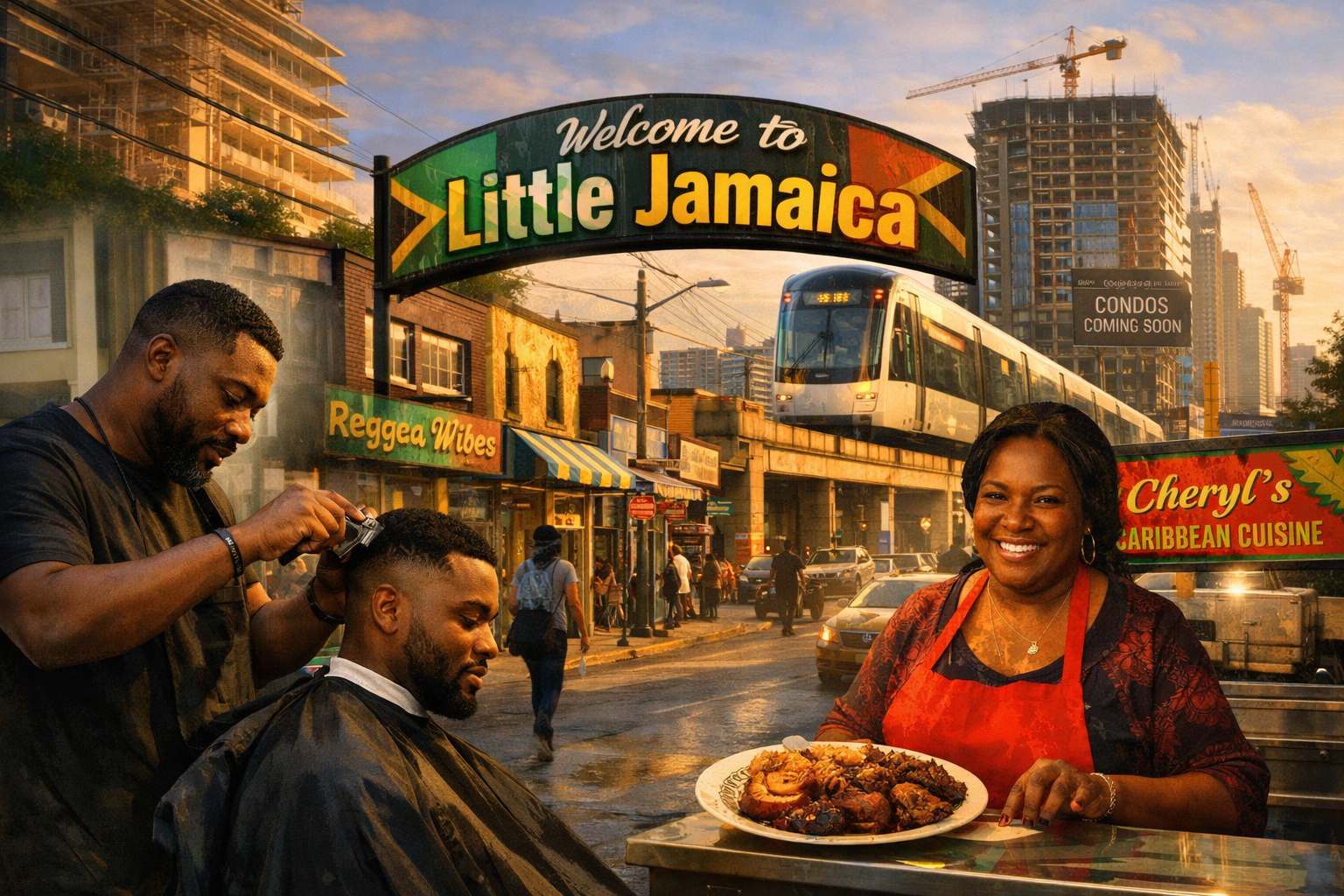
Once one of the largest Jamaican expat communities in the world, Little Jamaica along Eglinton Avenue West stood for more than food, music, and commerce. It represented Black self-determination, migration, entrepreneurship, and cultural continuity in Canada. Today, residents and business owners say that identity has been pushed to the brink after 15 years of construction tied to the Eglinton Crosstown LRT.
A Historic Black Cultural Corridor Under Strain
Little Jamaica emerged in the 1960s–1980s as Jamaican immigrants helped shape Toronto’s Black cultural footprint—barbershops, record stores, Caribbean restaurants, and community spaces became informal institutions. These were places where culture was preserved, jobs were created, and new arrivals found footing.
Black History Month often looks backward—but this moment demands we also look at what is being lost in real time.
Business owners like Jason McDonald of Casual Hair Salon and Cheryl of Cheryl’s Caribbean Cuisine describe years of blocked sidewalks, reduced visibility, and declining revenue—conditions that systematically weakened Black-owned businesses long before developers arrived.
“We’re not asking for handouts,” one owner says. “We’re asking for what’s right.”
Displacement Without Compensation
Despite motions passed by the City of Toronto in 2020 to support Little Jamaica businesses, owners say meaningful relief never arrived. While Metrolinx points to $1.38 million distributed across BIAs, community members argue that marketing grants and short-term events cannot undo years of financial harm, property damage, and forced closures.
This mirrors a familiar pattern in Black history:
-
Cultural districts thrive through community labor
-
Infrastructure projects disrupt them
-
Property values rise
-
Corporate ownership expands
-
Original residents are priced out
A Toronto Metropolitan University study cited in the report found that corporate-owned units in Little Jamaica more than tripled during construction—reshaping who controls the neighborhood’s future.
A Black History Month Question: Who Benefits?
The Eglinton LRT is framed as progress. And many in the community acknowledge it could bring foot traffic and opportunity. But Black History Month forces a harder question:
Who pays the price for progress—and who profits from it?
For property owners like Diana Lor, vibration damage, lost tenants, and vacant storefronts weren’t abstract inconveniences. They represented lost generational wealth—assets meant to be passed down to children.
“It’s not what do we want,” one voice says. “It’s what are we owed.”
Why This Story Belongs in Black History Month Coverage
Black History Month is not only about icons and anniversaries—it is about ongoing struggles for equity, recognition, and repair. Little Jamaica’s story belongs alongside conversations about:
-
Cultural erasure
-
Economic displacement
-
Urban planning and racial impact
-
Black Canadian history beyond celebration
As the LRT prepares to open, the community stands at a crossroads: revival or replacement.
The Future of Little Jamaica
Residents hope new transit brings customers—but fear it may also accelerate gentrification unless direct compensation, tenant protections, and cultural preservation policies are enacted.
Black History Month reminds us that Black spaces are not accidental—and once lost, they are rarely restored.
Little Jamaica is not just a neighborhood.
It is living history.
Share this content:











Post Comment