Gene Simmons Says Hip-Hop “Does Not Belong” in Rock & Roll Hall of Fame, Sparks Backlash
Gene Simmons’ Hip-Hop Comments Ignite Rock & Roll Hall of Fame Debate
Gene Simmons, co-founder and longtime bassist of KISS, has reignited a heated discussion about the place of hip-hop in music institutions — this time with blunt remarks about hip-hop’s induction into the Rock & Roll Hall of Fame.
Appearing on the Legends N Leaders podcast, Simmons criticized the Hall’s recognition of hip-hop artists, arguing that the genre is fundamentally different from traditional rock music and therefore doesn’t “belong” in an institution dedicated to rock and roll.
Simmons’s Argument: Cultural and Genre Distinctions
Simmons said he doesn’t personally connect with hip-hop, telling hosts:
“It’s not my music. I don’t come from the ghetto. It doesn’t speak my language.”
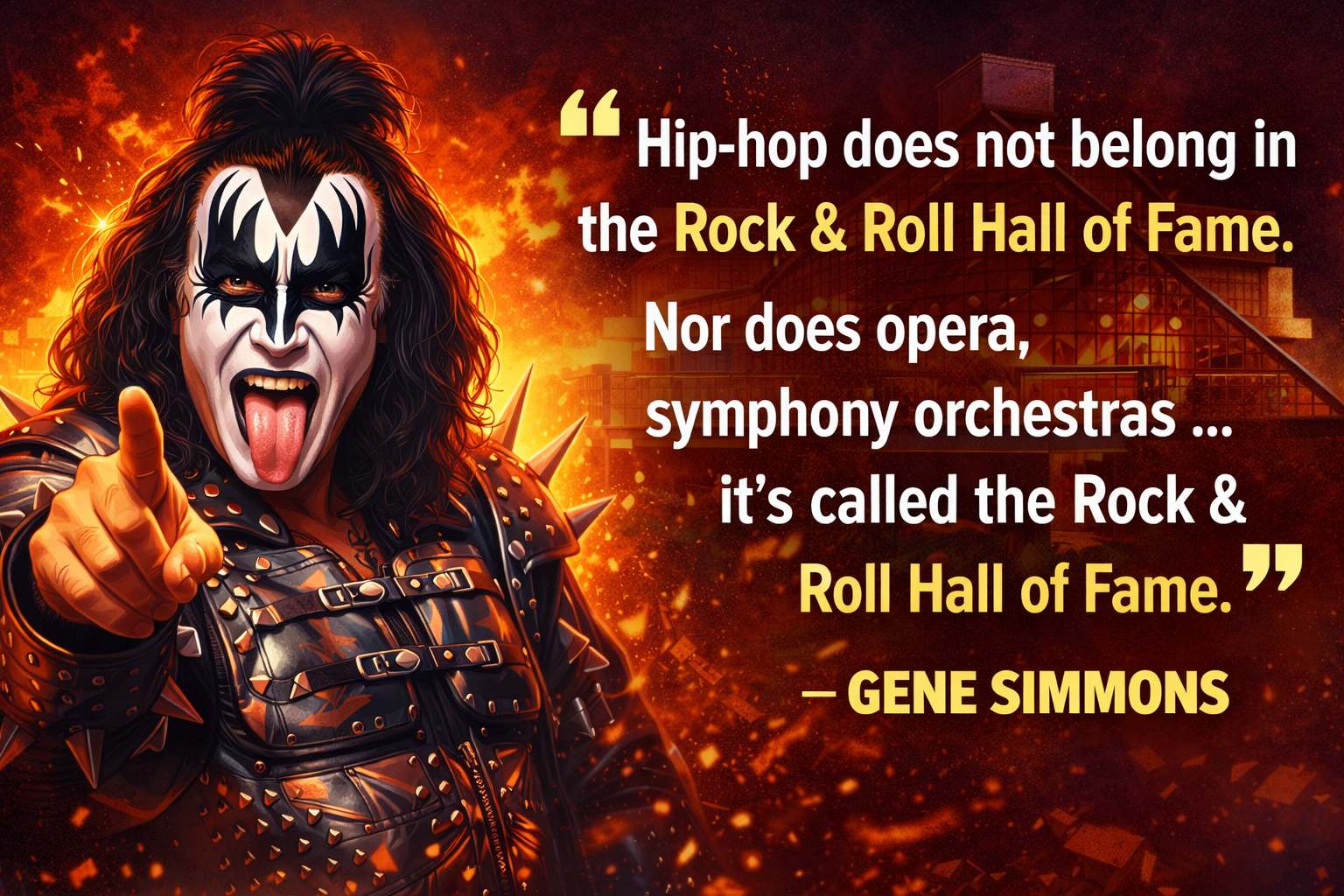
“Hip-hop does not belong in the Rock & Roll Hall of Fame, nor does opera, symphony orchestras… it’s called the Rock & Roll Hall of Fame.”
He contrasted the absence of certain rock acts — like heavy metal bands such as Iron Maiden — with the presence of hip-hop pioneers like Grandmaster Flash as inductees, questioning the consistency of the Hall’s selections.
Simmons further characterized rap and hip-hop mainly as a spoken-word form backed by beats rather than a traditional musical genre based on melody and instrumentation — a view that many artists and critics argue misunderstands hip-hop’s musical complexity.
Backlash and Broader Reactions
“It’s not my music. I don’t come from the ghetto. It doesn’t speak my language. I said in print many times: Hip-hop does not belong in the Rock & Roll Hall of Fame, nor does opera, symphony orchestras … it’s called the Rock & Roll Hall of Fame.”
— Gene Simmons on Hip-Hop being… pic.twitter.com/6UvXczw9HT
— Complex Music (@ComplexMusic) February 12, 2026
Simmons’s remarks have drawn immediate criticism across social media and music circles — many calling the comments tone-deaf or dismissive of hip-hop’s historical roots and cultural impact. Some critics labeled portions of his language as insensitive or culturally reductive.
Commentators pointed out that hip-hop has a long historical connection with rock and roll’s own origins. For example, Grandmaster Flash and the Furious Five were inducted into the Rock & Roll Hall of Fame in 2007, recognizing their groundbreaking influence on music and culture.
Artists such as Ice Cube — previously inducted with N.W.A. — have defended hip-hop’s place in the Rock Hall, arguing that the spirit of rock is about innovation and cultural fusion, not strict genre boundaries.
Historical Context: Why Hip-Hop in the Rock Hall?
It’s wild when white artists are directly influenced by Black musicians and still manage to be racist.
Gene Simmons and KISS took their entire image from Patti LaBelle’s rock group, LaBelle. KISS’s manager saw LaBelle’s costumes and asked the designer to create similar outfits. https://t.co/hoP0FCzTDX pic.twitter.com/Zsuf7Aiy9U
— Ola Ojewumi (@Olas_Truth) February 11, 2026
Hip-hop’s inclusion in the Rock & Roll Hall of Fame has been a topic of debate for years. Rock’s origins are deeply intertwined with African American music traditions, including rhythm and blues, funk, and jazz — styles that heavily influenced early hip-hop. Many see the genre’s cultural ethos — innovation, rebellion, social commentary and boundary-pushing — as part of rock’s broader legacy.
Artists such as Run-D.M.C. were inducted in 2009, further cementing hip-hop’s historical crossover into institutions once dominated by guitar-driven rock acts.
What This Debate Represents
Gene Simmons is correct on this. For the love of God. Please listen to him.
Hip Hop does not belong in the Rock and Roll Hall of Fame.
Why isnt there a Hip Hop Hall of fame?
— Jerome C. (@Jeromecaz) February 11, 2026
The controversy highlights larger questions about how musical genres evolve, how institutions codify culture, and who gets to define something as broad and fluid as “rock and roll.” Simmons’s statements have reopened discussions about genre gatekeeping, artistic legitimacy, and the diversity of musical expression honored in major halls of fame.
Whether one agrees or disagrees with Simmons, the public response shows that hip-hop’s influence is firmly cemented in the broader narrative of American music — and that definitions of “rock” are no longer confined to electric guitars and drums alone.
Share this content:













Post Comment