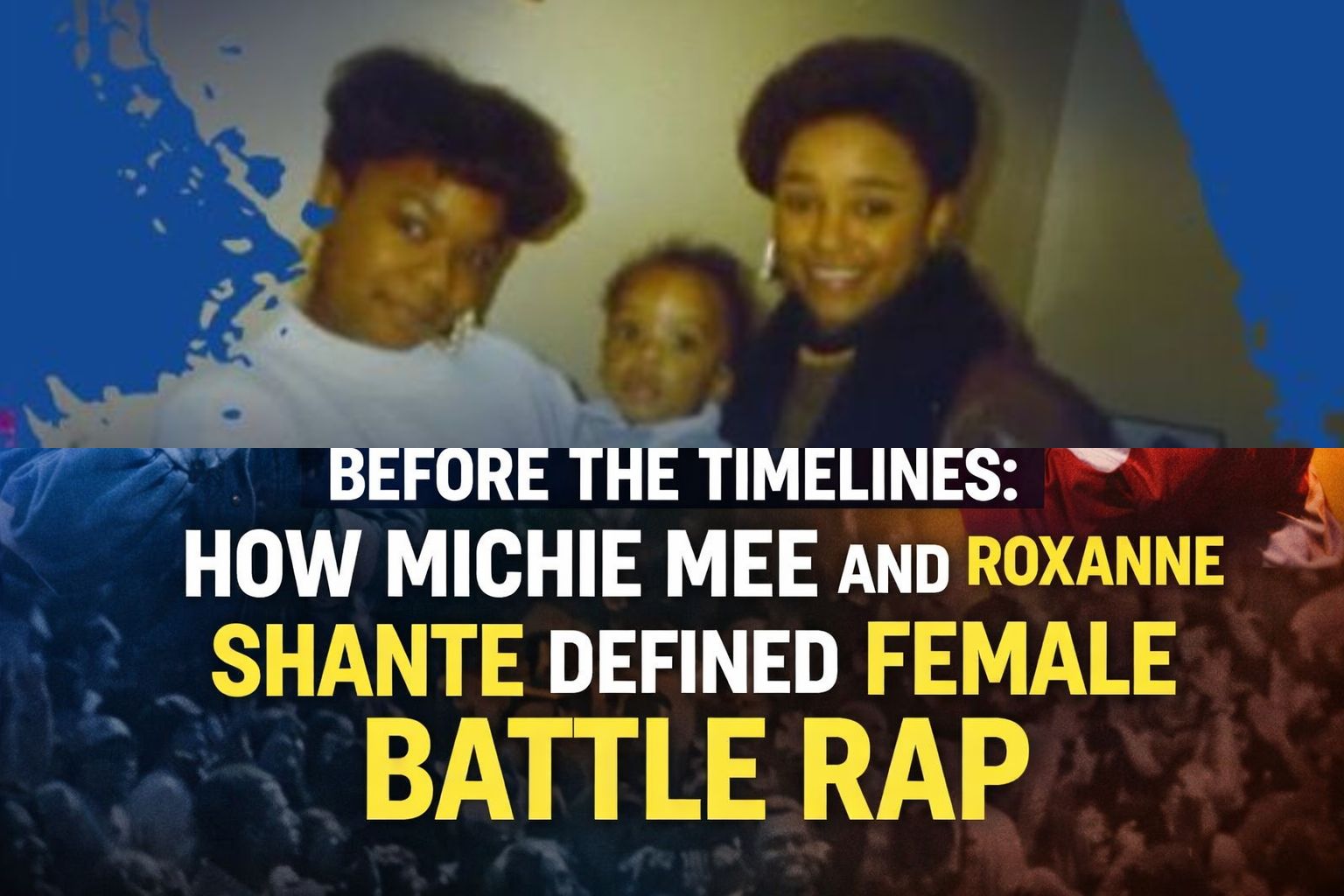
Before the Timelines: Michie Mee & Roxanne Shante’s Battle Legacy
Long before social media timelines, viral clips, or streaming-era beefs, female battle rap was already being shaped by artists who didn’t ask for permission—or approval. A newly resurfaced clip featuring Michie Mee and Roxanne Shante offers a rare reminder that the foundation of women battling in hip-hop was built on skill, crowd response, and cultural respect—not controversy.
The footage, now reintroduced through OG Origin Stories, captures a moment in Toronto that feels especially relevant today as conversations around female rappers, media attention, and battle culture resurface in the city.
When the Crowd Decided
View this post on Instagram
The clip opens with a moment many fans have never seen: MC Sugar standing before a Toronto crowd, asking who should win a rap battle between herself and Michie Mee. The response is immediate and unmistakable. The crowd cheers loudly for Michie Mee—an unfiltered reaction that speaks volumes about how skill and presence were valued in real time, long before online commentary shaped narratives.
Shortly after, a news reporter asks Michie Mee whether female rap is always about battling. Her response is telling. While battle culture played a role, it was never the full story. Bars, originality, and command mattered just as much.
The Original Female Battle Rappers
The clip then transitions into commentary from Kama, who places Michie Mee and Roxanne Shante in proper historical context. Roxanne Shante’s legendary battles—most notably against UTFO—are widely recognized as some of the first instances where a woman went head-to-head with male opponents and emerged victorious. Those moments weren’t framed as novelty; they were respected as competition.
Michie Mee, meanwhile, carried that same battle-ready energy into Canadian hip-hop, becoming a blueprint for female MCs in Toronto and beyond. Her presence wasn’t limited to local stages. She earned recognition across generations and borders, sharing cultural space with artists like Queen Latifah, MC Lyte, Drake, and even being honored in recent years by Nas.
Ahead of the Moment
One of the most striking observations made in the clip is how Michie Mee’s impact might be perceived if she emerged in today’s era. The argument is simple: if her prime had aligned with the last decade of global streaming and digital reach, her influence would likely be measured on the same scale as Toronto’s biggest exports. Not because of marketing—but because the foundation was already there.
Footage of Michie Mee performing internationally, including at major events in Jamaica, reinforces that her reach was never confined to one city or one era.
Why This History Matters Now
View this post on Instagram
As modern conversations swirl around female rappers, battle culture, and media coverage in Toronto, this clip serves as a grounding reminder: none of this is new. The city has seen women dominate crowds, command respect, and define the culture before. What’s changed isn’t the talent—it’s how quickly moments are amplified, debated, and sometimes distorted online.
By closing the clip with Michie Mee being declared the winner of the battle against MC Sugar, the story comes full circle. The crowd chose. The history is documented. And the lineage is undeniable.
In an era where timelines move fast, revisiting moments like this isn’t about nostalgia—it’s about context. And as Toronto once again debates how female rappers are received, the past offers a clear lesson: the foundation was already strong.
View this post on Instagram
Revisiting moments like this adds important context to today’s conversations around female rappers in Toronto. In a recent episode of Brooklyn’s Tea Talk, Brooklyn reflects on how women in the city continue to be judged, amplified, or overlooked—often only after controversy erupts. When viewed alongside the legacy of Michie Mee and Roxanne Shante, it becomes clear that the issue isn’t talent, but how and when attention is given.
Share this content:









Post Comment